Its been a long long time between serious news for the Sony DSLR user. The A700 was serious news. The A900 was serious news. Everything since then (including the very creditable A550 and A850) has been perfectly serviceable but nothing that really said, we are Sony, one of the powerhouses of consumer electronics, look at us. Instead, its been a long chain of dreary rehashes of the same basic three cameras, the A100, A700,A900. From that base, Sony has spawned the A200,230,290,300,330,380,390,450, 500, 550 and 850. And real progress has not really been made anywhere. A few tricks here and there (cool fast live view in some cameras etc) but really none of the ‘core’ camera functions have improved much.
Actually one thing that has changed, and we are mostly happy for, are the sensors. The move from the 10Mp CCD to 12Mp CMOS, 25Mp FF CMOS, 14Mp CMOS to the current 14Mp HD CMS in the NEX cameras has been excellent with improved resolution, DR, colour response and (most noticeably) high ISO performance between every generation. That said, however, the AF, metering, flash, control and customisation functions at the heart of a DSLR are little different between the June 2006 A100 and current June 2010 line-up of cameras.
So, here we are, the NEX camera and camcorder launch a few weeks behind us and another Photokina coming up about 60 days from now. What is going to happen next.
Well one site, Sony Alpha Rumours reckons it knows. Its suggesting:
Sony will introduce the two “translucent” cameras, the A55 (16MPX) and A33 (14MPX) -> (ultra fast autofocus during videorecording, very fast fps).
These ‘translucent cameras are based upon the pellical mirror technology discussed here and here.
My guess is the the different sensors (if this is true) point to the 14Mp sensor in the A550 and NEX series being the new ‘workhorse’ sensor for Sony. It will be fascinating to see if this sensor makes it way to Nikon or if Sony reckons that between the NEX series and based level A mounts it can make enough money. The presence of the 16Mp sensor probably signals what will drive the A7XX and (potentially) a future Nikon 400.
2) Sony will introduce two new Sony A5xx cameras with ExmorHD sensor. The higher-level camera will also be able to take 3D pictures (and it comes with GPS).
This is really surprising as the A500 and A550 are amongst the newest cameras in the Sony line-up and (apart from video) very competitive. And perhaps that the problem, today video is no longer an option, its seen as a requirement.
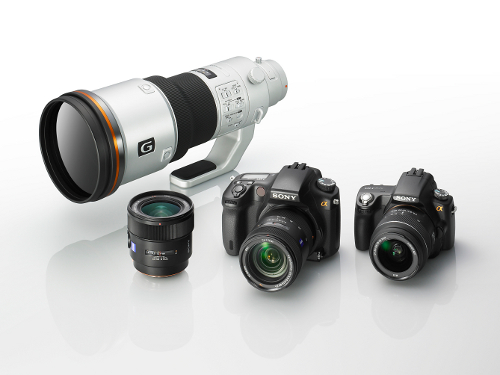
3) Many new lenses. Many current kit-lenses will be updated. The new Zeiss 24mm f/2.0 and Sony 500mm beast will finally come to market..
We always get sucked into talking about camera bodies but really it’s the lenses that many of us are really craving. The 24mm and 500mm are expected and there are strong rumours of an 16-80 CZ update. But what else is out there and what other ‘updates’ are required? My wild arsed guess, Sony is working on NEX compatibility for A mount lenses. What does this mean? Well I suspect at the least, some tweaks to AF processes (such as SSM in the CZ primes), possibly A mount lenses with Optical Stabilisation and most out there, electronic aperture support.
4) New NEX accessories are expected to be announced (electronic viewfinder???)
My guesses for NEX accessories. GPS, wireless unit(s), EVF.
If this rumour is true (and Sony Alpha Rumours doesn’t have the greatest reputation for getting it right) we are seeing almost a re-launch of the Sony Alpha brand. While it still doesn’t have the much desired A7XX (or the increasingly needed A8XX and A9XX) it would still be pretty big news.
Thursday, July 22, 2010

Wednesday, July 21, 2010
Two different approaches to a product
Micheal Reichmann, photographer, blogger, owner and operator of the Luminous Landscape site began as a photo guy with lots of discussion of images, their capture, processing and printing but most recently he seems to have been caught by the same gear driven, tech headedness that most of us on the net suffer from. This is really well illustrated by his response to the new Sony NEX-VG10 camcorder. Now I know nothing about video, but I must admit I was astounded at the vehemence of Michaels response on July 14 2010 to a product he has never touched on the basis for nothing more than a spec sheet.
It is really interesting to compare the Luminous Landscape comments with those from the guys at Endgadget. For me the most interesting difference is that the quite openly gear driven guys at Endgadget were infinitely more interested in actually using the device in their preview than in analysing the spec sheet. What drove these guys was what the camera could do, not what it couldnt, they considered how they would use it rather than how they wished they'd use it.
Now, I am being a little unfair, perhaps if Michael had a camera in his hands, like the Endgadget testers he would have reacted differently. Given Michaels inability to understand the NEX UI I dont hold out much hope.
It is really interesting to compare the Luminous Landscape comments with those from the guys at Endgadget. For me the most interesting difference is that the quite openly gear driven guys at Endgadget were infinitely more interested in actually using the device in their preview than in analysing the spec sheet. What drove these guys was what the camera could do, not what it couldnt, they considered how they would use it rather than how they wished they'd use it.
Now, I am being a little unfair, perhaps if Michael had a camera in his hands, like the Endgadget testers he would have reacted differently. Given Michaels inability to understand the NEX UI I dont hold out much hope.
Saturday, July 17, 2010
Sony NEX5 with Minolta 28-135

Ok, I havent spoken about it much yet but I have joined the Sony NEX(t) generation and am loving it. I got the camera about three weeks ago and the A to E adapter last week.
So far I've really only been playing around and I havent tried to take any "serious" photos yet. (I'm in the middle of a major overhaul of my entire photography working regime that is actually getting in the way of just taking photos right now). Hopefully I'll get that fixed very shortly.
Anyway, so far so good. A fuller report to come soon, but just for kicks here's a snapshot of the little NEX on the Minolta 28-135. This isnt really an ideal configuration but it sure is fun.
Sony and the A7XX saga
The single biggest discussion point on every Sony Alpha oriented forum I frequent concerns the mythical A7XX, the A700 follow on. When will it come? What will it be like? Will it confirm our hopes that Sony is going head to head with Canon and Nikon or will it confirm our fears that Sony will dumb it down? Why oh why was the A700 discontinued with no successor.
I feel the same angst as everyone else and as a result I'm still not buying any new A mount stuff. But then again, being more dispassionate I would say Sony was kind of stuck with the A7xx.
Look at the opposition in the meantime.
1. Nikon has released the D300s, a very mild warm over that gathered coverage for about 10 minutes then the world shrugged and moved on. Still it was worth it because there is a huge nikon user base that just keeps buying stuff so of course it made sense to keep production going. Still no idea on a genuine upgrade.
2. Canon very quickly replaced the 40D with the 50D because the 40D was an embarassment for the company that sees itself as the market leader and default 'pro' choice. Not saying that it was a bad camera but go back and read the reviews of how it was compared to the Nikon (and even Sony/Pentax) at the time. Also remember what else was going on then, the D3/D700 was all the rage, Nikon grabbed huge market share and Canon had to act.
3. Despite the 50D Canon was still obviously off the pace in the $US1200-1900, aps pro, segment and everyone new it. It had to get something out and it did - eventually - with the 7D.
4. In the meantime the market has gone crazy for mirrorless cameras and that segment is exploding and we have nothing from either of the big 2 except the promise of an announcement later from Nikon.
5. Sony new the A700 was off the pace but what to do?
a) keep it going potentially leading to a whole lot of embarrassing reviews with a tiny production volume?
b) release a D300s/D50 warm over that sucked up a lot of resources, still probably only had a tiny production run and not gained it much cred?
c) bite the bullet and carry a hole for 12 months and get on with business (like getting the NEX out)?
Personally I reckon option A is a non starter and only option B or C were viable. I also reckon none of us really know what would have been smarter from a business POV. I would have preferred B but I can understand Sony's choice of C.
Look at the opposition in the meantime.
1. Nikon has released the D300s, a very mild warm over that gathered coverage for about 10 minutes then the world shrugged and moved on. Still it was worth it because there is a huge nikon user base that just keeps buying stuff so of course it made sense to keep production going. Still no idea on a genuine upgrade.
2. Canon very quickly replaced the 40D with the 50D because the 40D was an embarassment for the company that sees itself as the market leader and default 'pro' choice. Not saying that it was a bad camera but go back and read the reviews of how it was compared to the Nikon (and even Sony/Pentax) at the time. Also remember what else was going on then, the D3/D700 was all the rage, Nikon grabbed huge market share and Canon had to act.
3. Despite the 50D Canon was still obviously off the pace in the $US1200-1900, aps pro, segment and everyone new it. It had to get something out and it did - eventually - with the 7D.
4. In the meantime the market has gone crazy for mirrorless cameras and that segment is exploding and we have nothing from either of the big 2 except the promise of an announcement later from Nikon.
5. Sony new the A700 was off the pace but what to do?
a) keep it going potentially leading to a whole lot of embarrassing reviews with a tiny production volume?
b) release a D300s/D50 warm over that sucked up a lot of resources, still probably only had a tiny production run and not gained it much cred?
c) bite the bullet and carry a hole for 12 months and get on with business (like getting the NEX out)?
Personally I reckon option A is a non starter and only option B or C were viable. I also reckon none of us really know what would have been smarter from a business POV. I would have preferred B but I can understand Sony's choice of C.
Now, with 20/20 hindsight and zero visibility inside Sony I think Sony could have done better, however, Im I have no idea if much would have really changed. Just for a minute forget companies and think in terms of 'mount'. The A mount, F mount and (whats canon?) call it the EOS mount.
When you look at the F and EOS mounts we see this long, unbroken line of development, using Nikon the F3,4,5,6,D1,D1S,D2,D2S,D3,D3S plus X's and H's thrown in there. From this AF modules, flash systems, metering systems, control methods have had this nice steady flow, a consistent maturation leading almost inevitably to where we are now. The Canon flow is pretty similar.
Comparing that to the A mount flow, its clear that we have not been as well served. The A mount has had a number of changes in direction, long periods of hiatus, spurts of growth and stagnation not to mention a near bankruptcy, a corporate merger and finally a complete change of ownership in its last few years under what appeared to be pretty chaotic circumstances. Dont forget that when it took over the A mount it was almost dead in the water with perhaps 1-2% (on a good day) of DLSR sales. I'm only guessing but I'd think that this has resulted in significant technical and management churn over probably a few decades punctuated by the occasional massive dislocation.
On top of that add that the last owner in the history is also, at the very highest levels of the corporation, struggling to define themselves but are also suppliers to their own product's key competitors.
This lack of direction and inability to forge a culture is clearly evident in the alpha line.
In that context I wonder if we were ever going to be in a very different position without a heroic effort from Sony.
But, lots of companies face challenges, find new ways of proceeding and move on from those challenges - they find heroes - Sony has not. Therefore, while I understand why we are where we are, I dont excuse Sony. From where we sit we've seen Sony squander some simple opportunities, make some really dumb calls and pursue marketting strategies that deny explanation. They should do better and we should demand more - however, I often believe that without an understanding of the full context our demands are unreasonable, and being unreasonable, are easy to ignore.
Personally I think the great hope for A mount users is the E mount. I hope (and it is only hope) that the growth of the E mount will lead to the adoption of the A mount into the highly successful video family in Sony and provide a consistency of vision and direction that has been lacking in the A mount for perhaps 20 years.
When you look at the F and EOS mounts we see this long, unbroken line of development, using Nikon the F3,4,5,6,D1,D1S,D2,D2S,D3,D3S plus X's and H's thrown in there. From this AF modules, flash systems, metering systems, control methods have had this nice steady flow, a consistent maturation leading almost inevitably to where we are now. The Canon flow is pretty similar.
Comparing that to the A mount flow, its clear that we have not been as well served. The A mount has had a number of changes in direction, long periods of hiatus, spurts of growth and stagnation not to mention a near bankruptcy, a corporate merger and finally a complete change of ownership in its last few years under what appeared to be pretty chaotic circumstances. Dont forget that when it took over the A mount it was almost dead in the water with perhaps 1-2% (on a good day) of DLSR sales. I'm only guessing but I'd think that this has resulted in significant technical and management churn over probably a few decades punctuated by the occasional massive dislocation.
On top of that add that the last owner in the history is also, at the very highest levels of the corporation, struggling to define themselves but are also suppliers to their own product's key competitors.
This lack of direction and inability to forge a culture is clearly evident in the alpha line.
In that context I wonder if we were ever going to be in a very different position without a heroic effort from Sony.
But, lots of companies face challenges, find new ways of proceeding and move on from those challenges - they find heroes - Sony has not. Therefore, while I understand why we are where we are, I dont excuse Sony. From where we sit we've seen Sony squander some simple opportunities, make some really dumb calls and pursue marketting strategies that deny explanation. They should do better and we should demand more - however, I often believe that without an understanding of the full context our demands are unreasonable, and being unreasonable, are easy to ignore.
Personally I think the great hope for A mount users is the E mount. I hope (and it is only hope) that the growth of the E mount will lead to the adoption of the A mount into the highly successful video family in Sony and provide a consistency of vision and direction that has been lacking in the A mount for perhaps 20 years.
Friday, July 16, 2010
Sony and Photokina 2010 - 66 Days to Go
Photokina is just 66 days away and as usual, this is critical juncture for Sony and the alpha line (when wasnt the alpha line at a critical juncture?) Anyway I've decided to get this blog back on a roll with my guesses as to what Sony is going to do at this big event.
1. After a quiet period, Sony will make a bit of a splash at this one.
2. We will get the two bodies shown to us earlier released:
3. These will be an A7XX and an A5XX.
4. The specs will be ok but nothing earth shattering, however, Sony will continue to blur the lines between entry/enthusiast/pro which will really annoy most people here and will get (at best) lukewarm coverage from the camera sites that specialise in equipment testing.
5. The 500 G and 24 CZ will be actually released,
6. There will not be an NEX7.
7. There will be some more NEX lenses, at least one will be either a G or a CZ (I'm 90% sure its would be a CZ as that has more cache - deserved or not)
Now more "out there" guesses:
8. There will be a mock up displayed of the A9XX.
9. The NEX camcorder will be released.
1. After a quiet period, Sony will make a bit of a splash at this one.
2. We will get the two bodies shown to us earlier released:
3. These will be an A7XX and an A5XX.
4. The specs will be ok but nothing earth shattering, however, Sony will continue to blur the lines between entry/enthusiast/pro which will really annoy most people here and will get (at best) lukewarm coverage from the camera sites that specialise in equipment testing.
5. The 500 G and 24 CZ will be actually released,
6. There will not be an NEX7.
7. There will be some more NEX lenses, at least one will be either a G or a CZ (I'm 90% sure its would be a CZ as that has more cache - deserved or not)
Now more "out there" guesses:
8. There will be a mock up displayed of the A9XX.
9. The NEX camcorder will be released.
(whoops - already done)
10. There will be a couple of lenses, software suites and other accessories for the NEX range to also blur the lines between still and video work.
So over to you - what do you think will happen?
10. There will be a couple of lenses, software suites and other accessories for the NEX range to also blur the lines between still and video work.
So over to you - what do you think will happen?
(note, I have no inside sources, know no one in the company and all this is total arse pluck)
Wednesday, March 3, 2010
Sand dunes and the power of black and white


The Sygna morning shoot yielded so many great photo opportunities I'm still wading through, processing and posting them.
Maybe I'm just bandwagon jumping seeing as my last b&w dunes shots got explored but I really do think they work. Why? I think its because there is so little detail and such a limited array of colours that the core of the images becomes just the play of light and shade, something B&W handles really nicely.
Monday, March 1, 2010
Working the scene



Returning to a familiar theme here on the importance of working the scene.
When you spend several hours with the same subject through a sun rise you get lots of opportunities to experiment. Add to that a few more hours of processing and you can really go to town. Here's a whole bunch of photos of the same subject (The Sygna) from basically the same spot but with a lot of variation in exposure and processing.
One way of expanding your boundaries as a photographer is to stop chasing new scenes but instead concentrate on new ways of capturing and presenting the one scene before you.
Subscribe to:
Posts (Atom)